What the Harvard study found
Zhang et al. · Nature · January 2020
Stress empties the follicle's pigment reserve — permanently
Each hair follicle holds a small reserve of melanocyte stem cells. When a new hair grows, some of them mature into melanocytes, the cells that make the pigment. The reserve tops itself back up. That cycle is what keeps hair its original color.
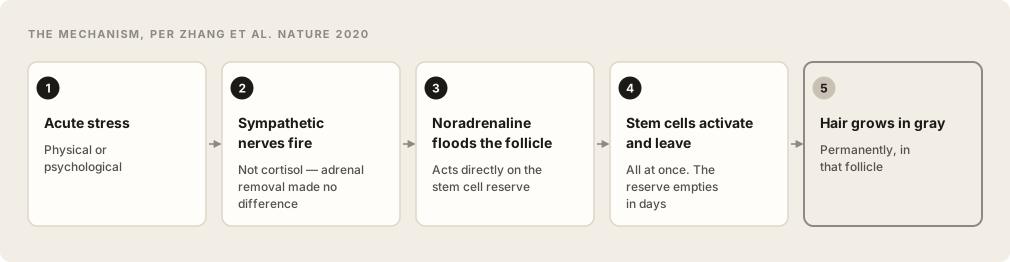
Ya-Chieh Hsu's team at Harvard exposed mice to several forms of stress and watched what happened to that reserve. The stem cells didn't die — they activated all at once, matured into pigment cells, and migrated out of the follicle. Within days the reserve was empty. Every hair grown after that came through unpigmented.
The interesting part is what wasn't responsible. The team expected cortisol or an immune attack. Removing the adrenal glands made no difference. Silencing the sympathetic nerves stopped the graying entirely, and artificially activating those nerves caused graying without any stress at all. The culprit was noradrenaline — the fight-or-flight neurotransmitter — acting directly on the stem cells.
And then a human study complicated it
Rosenberg et al. · eLife · June 2021
Some graying reverses
Martin Picard's group at Columbia developed a way to read a single hair like a tree ring. Because a hair shaft hardens as it grows and then stops changing, its pigment pattern along the length is a physical record of what the follicle was doing month by month.
Scanning hairs from fourteen volunteers aged nine to sixty-five, they found something that had only ever been reported in isolated case studies: individual hairs that were white at one point along the shaft and pigmented further along. Color returning, not just leaving.
When participants mapped their stressful periods against those transitions, the patterns lined up. One case involved a two-week holiday during which several graying hairs began repigmenting.
How the two fit together
They aren't contradictory, and the researchers involved don't think they are. The likely reading is that there's a window. A follicle pushed toward graying by stress may still recover if the reserve hasn't been fully exhausted. Once those stem cells are genuinely gone, that follicle is finished — and that is what the Harvard work describes.
Both groups landed in a similar place: stress appears to accelerate a process that would happen with age anyway, rather than starting something new.
How much of your gray is actually stress?
Less than you'd guess. A 2016 genome-wide study of more than 6,000 people identified IRF4 as the first gene associated with human hair graying, and the researchers estimated it accounted for around 30% of the variation — with age and other factors making up the rest.
Put practically: if your parents grayed in their thirties, you probably will, whatever your job is like. Stress moves the timing. It doesn't set the schedule.
Other factors with reasonable support include smoking, and deficiencies in vitamin B12, ferritin or vitamin D where graying arrives unusually early.
So what should you actually do?
If graying is your only concern, the honest answer is that managing stress for the sake of your hair is the wrong reason to manage stress. The pigment benefit is uncertain and modest. Every other benefit is neither.
Two things are worth doing on their own merits:
- If graying arrived early — before about thirty — ask your doctor for blood work: B12, ferritin, vitamin D and thyroid function. Correcting a real deficiency is the one intervention with a plausible route to affecting pigment, and it's cheap.
- If you smoke, stop. It's among the few lifestyle factors that shows up consistently in the graying literature, and the case for stopping was already overwhelming.
Beyond that, be skeptical of anything sold as a gray-hair reversal supplement. No product has been shown to reliably restore pigment to hair that has already turned, and the best-known claim that one does turns out, on reading it, to be about hair loss rather than pigment.
Sources
- Zhang, B. et al. Hyperactivation of sympathetic nerves drives depletion of melanocyte stem cells. Nature 577, 676–681 (2020). nature.com
- Rosenberg, A. M. et al. Quantitative mapping of human hair graying and reversal in relation to life stress. eLife 10:e67437 (2021). elifesciences.org
- Adhikari, K. et al. A genome-wide association scan in admixed Latin Americans identifies loci influencing facial and scalp hair features. Nature Communications 7:10815 (2016).
- National Institutes of Health — How Stress Causes Gray Hair. nih.gov