Where hair color comes from
Every hair follicle contains melanocytes — cells that manufacture melanin, the pigment that gives hair its color. More melanin means darker hair; less means lighter. Two types are involved, one producing brown and black tones, the other red and yellow, and the blend determines your natural shade.
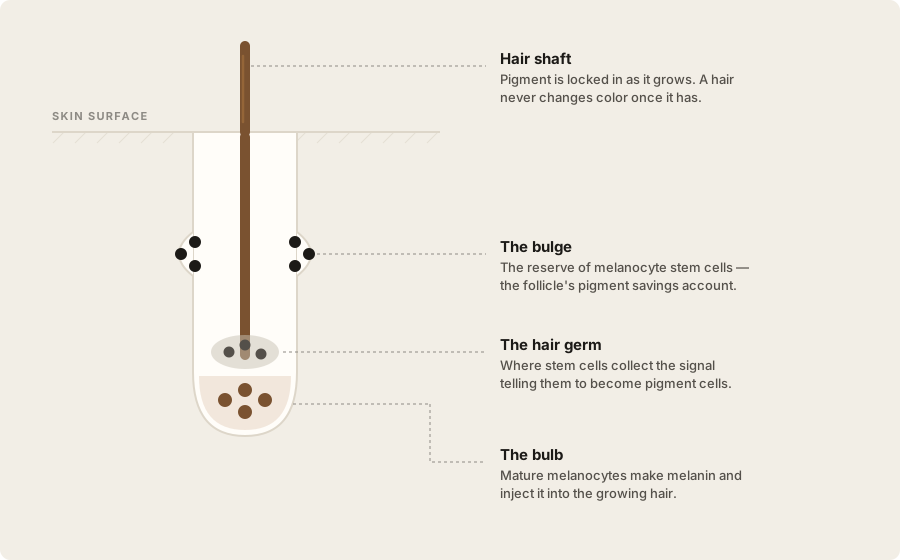
Melanocytes don't last. They're consumed during each hair growth cycle and replaced from a reserve of melanocyte stem cells living in a region of the follicle called the bulge. As long as that resupply works, hair keeps its color. Gray hair is what grows when it stops.
The current best explanation: stem cells that get stuck
Sun et al. · Nature · April 2023
Loss of mobility, not loss of cells
A team at NYU Grossman School of Medicine, led by Mayumi Ito, tracked fluorescently labeled melanocyte stem cells in mice over two years. What they found overturned the standard model of how these cells behave.
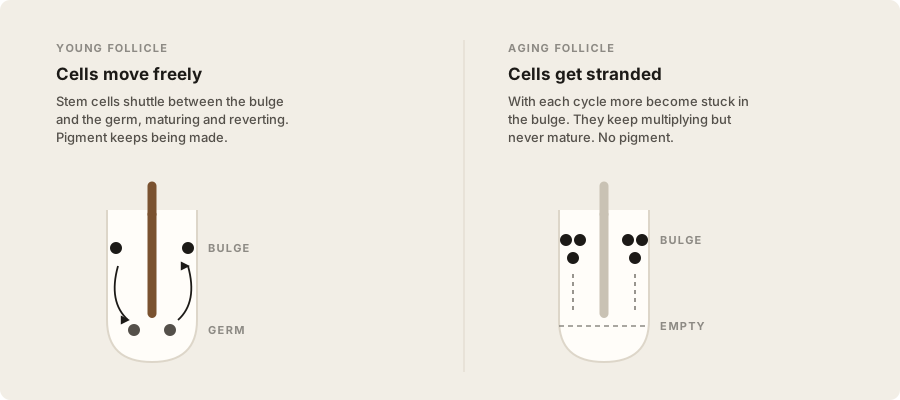
Stem cells were assumed to travel one way: stem cell, then progenitor, then mature cell, never back. Melanocyte stem cells turned out to be far more flexible than that. They shuttle back and forth between the bulge and an area called the hair germ, maturing and then de-maturing, picking up different signals in each compartment. The germ is where they receive the WNT signals that tell them to become pigment cells.
With each successive growth cycle, more of them became trapped in the bulge, unable to make the return trip. Stranded there, they kept multiplying but never matured, and never made pigment. Cells that retained the ability to move kept producing color for the full two years.
Ito described it as the loss of a chameleon-like function. The team's stated next step is to look at whether that mobility can be restored.
This is a genuinely promising line of research, and it's worth being clear about what it is: a mechanism identified in mice, with no treatment attached to it. Nothing on sale today acts on it.
What actually determines when it happens to you
1. Genetics — the dominant factor
In 2016, a genome-wide study of more than 6,000 people across five Latin American countries identified IRF4 as the first gene linked to human hair graying. IRF4 helps regulate the production and storage of melanin. The researchers estimated the genetic contribution at roughly 30% of the variation, with age and other factors accounting for the rest. In plain terms: if your parents went gray early, expect to.
2. Age — the engine
Melanocyte stem cell function declines in essentially everyone. It fails earlier than the stem cell system responsible for hair growth itself, which is why plenty of people have a full head of gray hair. Onset differs across populations: it typically begins earlier in people of European descent, with Asian and African populations tending to gray around a decade later on average.
3. Oxidative stress
Melanin production generates hydrogen peroxide as a by-product. Follicles normally neutralize it, but that capacity declines with age, and accumulated peroxide interferes with melanin synthesis and damages the cells making it. Oxidative stress runs through most proposed mechanisms of graying, which is why antioxidants get marketed heavily for it — without, so far, convincing clinical results.
4. Psychological stress
Real, and now mechanistically explained. A 2020 Harvard study found that acute stress triggers noradrenaline release from sympathetic nerves, which drives melanocyte stem cells to activate all at once and leave the follicle, exhausting the reserve. A 2021 Columbia study found individual human hairs can regain pigment when stress subsides. We covered both studies in detail here.
5. Smoking
One of the few lifestyle factors with a consistent association in the literature, and one of the few you can act on.
6. Nutritional deficiency
Vitamin B12, ferritin and vitamin D deficiencies have been repeatedly associated with premature graying in case-control studies, several of them conducted in India. The evidence base is regional and the studies are small, but the mechanism is plausible — B12 and iron matter to follicle function and pigmentation — and testing is cheap. This is the one category where correcting the cause has a realistic chance of affecting the outcome.
7. Medical conditions
Thyroid disorders, vitiligo and some autoimmune conditions are associated with early graying. If hair color loss is patchy, sudden, or accompanied by other symptoms, that's a reason to see a doctor rather than a supplement retailer.
Can gray hair be reversed?
Not reliably, and not by anything currently for sale.
There are three honest qualifications. Recently grayed hairs sometimes repigment on their own, as the Columbia work documented. Graying driven by a correctable deficiency or a treated medical condition can improve. And repigmentation has been observed as an incidental side effect of certain drugs, which is a curiosity rather than a treatment.
What has not been demonstrated is a supplement, shampoo, serum or device that restores pigment to hair that has already turned. If a product claims otherwise, ask what trial supports it — and whether the trial was run by the company selling it.
What's worth doing
- Get bloods done if it started early. B12, ferritin, vitamin D and thyroid function. Before thirty is worth investigating; before twenty definitely is.
- Stop smoking. The graying association is the least of the reasons.
- Skip the supplements otherwise. Topping up nutrients you already have enough of does nothing, and the reversal products don't work.
- Color it or don't. Those remain the two real options, and neither is a failure.
Sources
- Sun, Q. et al. Dedifferentiation maintains melanocyte stem cells in a dynamic niche. Nature 616, 774–782 (2023). DOI 10.1038/s41586-023-05960-6
- Zhang, B. et al. Hyperactivation of sympathetic nerves drives depletion of melanocyte stem cells. Nature 577, 676–681 (2020).
- Rosenberg, A. M. et al. Quantitative mapping of human hair greying and reversal in relation to life stress. eLife 10:e67437 (2021). elifesciences.org
- Adhikari, K. et al. A genome-wide association scan in admixed Latin Americans identifies loci influencing facial and scalp hair features. Nature Communications 7:10815 (2016).
- National Institutes of Health — Aging melanocyte stem cells and gray hair. nih.gov
- NYU Langone Health — Study Links "Stuck" Stem Cells to Hair Turning Gray. nyulangone.org